by
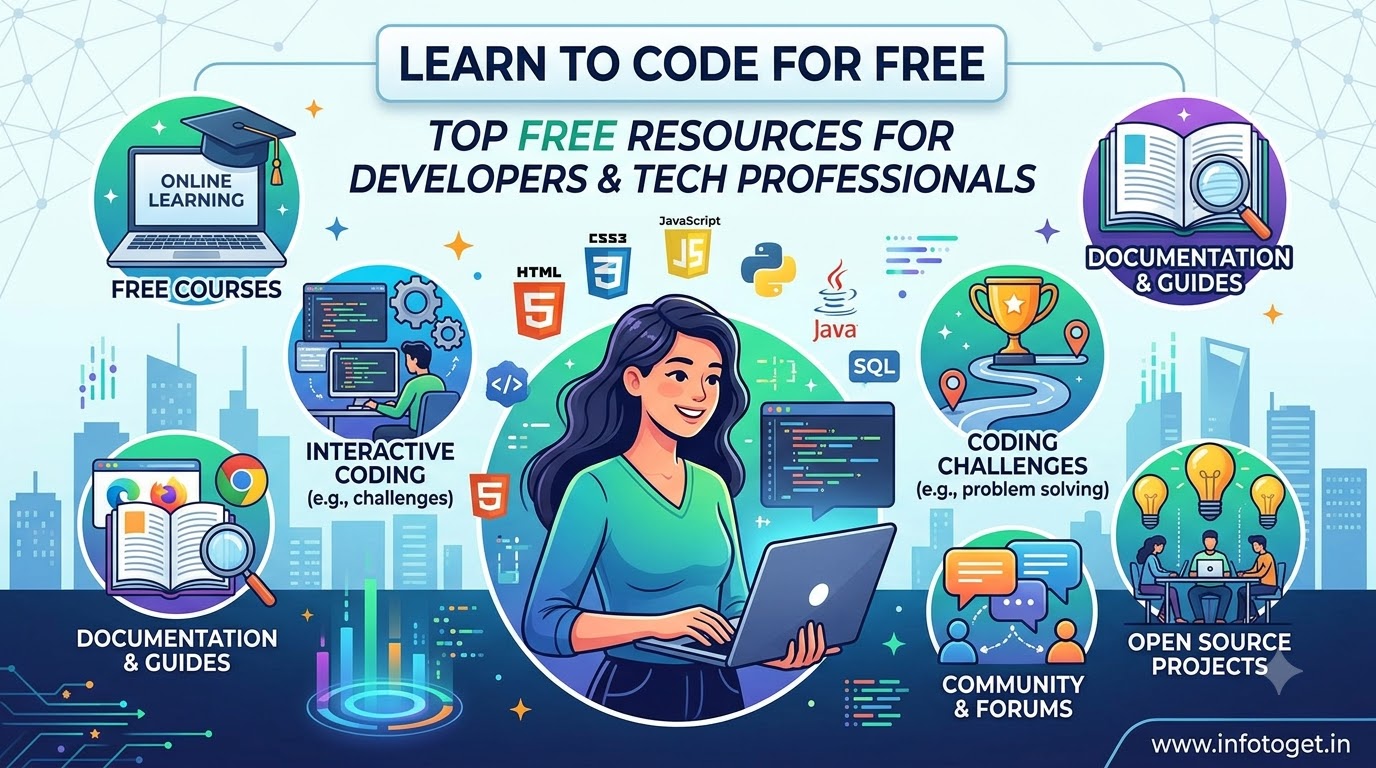
Learning to code, build websites, manage databases, or secure cloud infrastructure used to require expensive university degrees or costly coding bootcamps. Today, the tech industry values practical skills, hands-on portfolio projects, and problem-solving ability far more than formal certificates.
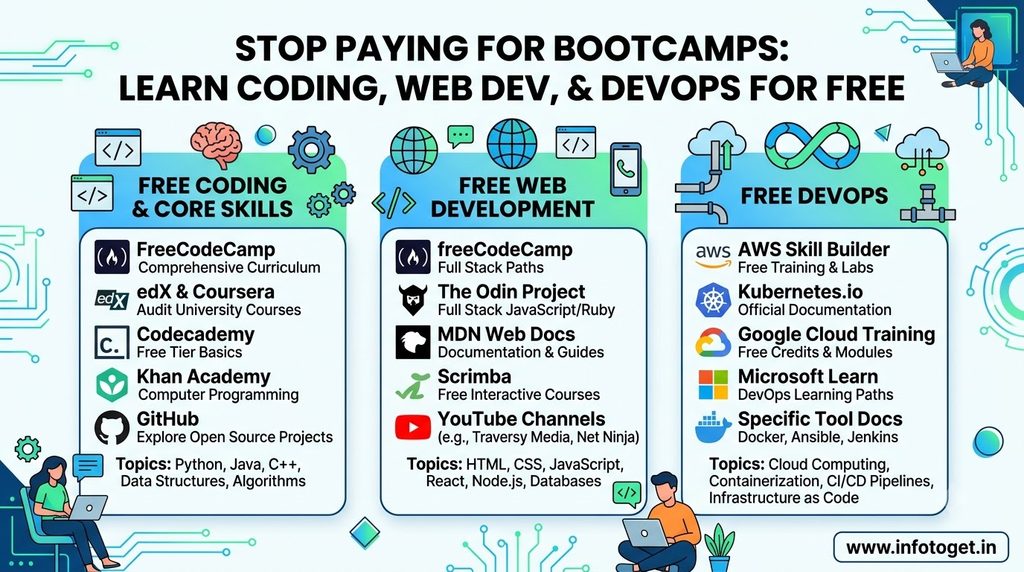
The reference image highlights a goldmine of curated, high-quality, completely free learning platforms for every major technology stack—ranging from core web development to advanced cloud platforms and cybersecurity.
This comprehensive guide breaks down every tech track from the image with detailed explanations, practical career benefits, and exact learning steps to help self-taught developers master these tools and build rewarding tech careers.

Phase 1: Foundational Web Development (Frontend Basics)
Every developer journey starts with understanding how web pages are built, styled, and made interactive.
- HTML (HyperText Markup Language)
- Resource: html.com
- Overview: HTML forms the fundamental skeleton of every page on the Internet. It defines elements like headings, paragraphs, forms, and images.
- Why Learn It: Mastering semantic HTML is essential for building accessible websites, improving search engine optimization (SEO), and creating clean document structures.
- CSS (Cascading Style Sheets)
- Resource: web.dev/learn/css
- Overview: Maintained by Google engineers, web.dev offers structured lessons covering modern layout techniques like Flexbox, CSS Grid, media queries, and animations.
- Why Learn It: CSS turns raw HTML into visual, modern, responsive websites that look great across desktop computers, tablets, and mobile smartphones.
- JavaScript
- Resource: javascript.info
- Overview: Known as the Modern JavaScript Tutorial, this platform covers everything from beginner syntax to advanced asynchronous functions, DOM manipulation, and closure concepts.
- Why Learn It: JavaScript is the core programming language of the web. It brings dynamic functionality, user interactions, and real-time features to websites.
Phase 2: Modern Frontend Frameworks
Once core JavaScript is clear, web developers adopt modern frameworks to build complex single-page applications efficiently.
- React
- Resource: reactplay.io
- Overview: A community-driven platform for learning React by building real-world open-source projects.
- Why Learn It: Developed by Meta, React is currently the most popular JavaScript frontend library in the global job market.
- Vue.js
- Resource: learnvue.co
- Overview: Offers approachable tutorials covering Vue 3, Composition API, state management, and template syntax.
- Why Learn It: Vue is renowned for its gentle learning curve, clean documentation, and high productivity for building fast web interfaces.
- Angular
- Resource: angular.dev/tutorials
- Overview: The official Angular documentation providing hands-on coding environments directly in your web browser.
- Why Learn It: Built by Google, Angular is a comprehensive enterprise-grade framework widely used by large corporations and financial institutions.
- Next.js
- Resource: nextjs.org/learn
- Overview: An interactive tutorial created by Vercel that teaches Server-Side Rendering (SSR), Static Site Generation (SSG), and modern full-stack React patterns.
- Why Learn It: Next.js powers lightning-fast, production-ready web apps with built-in performance optimization and SEO capabilities.
Phase 3: Core Programming Languages & Backend Development
Backend development handles server logic, API management, business processing, and database operations.
- Python
- Resource: learnpython.org
- Overview: An interactive coding tutorial covering basic variable types, loops, functions, and data science concepts.
- Why Learn It: Python is famous for its simple syntax and is widely used in web development, data analysis, automation scripts, and Artificial Intelligence.
- PHP
- Resource: phptherightway.com
- Overview: A quick-reference guide that introduces best practices, modern standards, security measures, and database connections in PHP.
- Why Learn It: PHP powers a massive portion of the modern web, including content management systems like WordPress.
- Go (Golang)
- Resource: learn-golang.org
- Overview: An interactive walkthrough designed by Google engineers to teach concurrent programming, syntax, and memory handling.
- Why Learn It: Go is built for high-performance microservices, cloud infrastructure tools, and scale technology environments.
- Rust
- Resource: rust-lang.org/learn
- Overview: Includes “The Rust Programming Language” official book, hands-on exercises, and compiler guidance.
- Why Learn It: Rust delivers extreme performance and memory safety without a garbage collector, making it top-rated for system engineering, WebAssembly, and high-security software.
- TypeScript
- Resource: typescriptlang.org/docs
- Overview: Official documentation explaining strongly typed JavaScript, interfaces, generics, and compiler configurations.
- Why Learn It: TypeScript prevents runtime bugs by adding static typing to JavaScript projects, making large codebases much easier to maintain.
- C++
- Resource: cplusplus.com/doc/tutorial
- Overview: Detailed tutorials covering object-oriented programming, memory pointers, data structures, and low-level resource management.
- Why Learn It: C++ powers high-performance game engines, operating systems, desktop tools, and embedded hardware systems.
- Java
- Resource: docs.oracle.com/javase/tutorial
- Overview: Official Oracle learning paths covering Java object-oriented programming, collections frameworks, multithreading, and platform security.
- Why Learn It: Java remains a foundational pillar for enterprise software engineering, banking portals, and Android app development.
- C# (.NET)
- Resource: dotnet.microsoft.com/learn/csharp
- Overview: Official Microsoft video courses and browser-based exercises for learning modern C# and .NET frameworks.
- Why Learn It: Essential for enterprise Windows applications, web APIs, and Unity game development.
- Swift
- Resource: swift.org/learn
- Overview: The official open-source community portal for learning Apple’s modern Swift programming language.
- Why Learn It: Swift is the primary language used to build applications across iOS, iPadOS, macOS, and watchOS devices.
Phase 4: Backend Frameworks & APIs
- Django
- Resource: djangoproject.com/start
- Overview: The official quick-start guide for Python’s feature-rich web framework.
- Why Learn It: Follows a “batteries-included” approach with built-in authentication, database ORM, and admin dashboards ready to use.
- Flask
- Resource: flask.palletsprojects.com/tutorial
- Overview: Official step-by-step documentation for building micro-web applications using Python.
- Why Learn It: Lightweight and flexible, perfect for small APIs and microservices.
- APIs (Application Programming Interfaces)
- Resource: rapidapi.com/learn
- Overview: Interactive developer guides covering RESTful design, GraphQL endpoints, authentication headers, and JSON responses.
- Why Learn It: APIs connect frontend user interfaces with backend databases and third-party services.
Phase 5: Databases, Version Control & System Architecture
- SQL (Structured Query Language)
- Resource: w3schools.com/sql
- Overview: Hands-on tutorials for database queries, JOIN operations, data manipulation, and table indexing.
- Why Learn It: SQL is required to store, query, and manage relational database systems like PostgreSQL, MySQL, and SQL Server.
- Git Version Control
- Resource: git-scm.com/book
- Overview: The free “Pro Git” book detailing commits, branches, merge conflicts, pull requests, and distributed team workflows.
- Why Learn It: Git is mandatory for every software developer to track code changes and collaborate with engineering teams.
- Design Patterns
- Resource: refactoring.guru
- Overview: Visually engaging guides explaining software architecture design patterns like Singleton, Factory, Observer, and SOLID principles.
- Why Learn It: Teaches developers how to write clean, scalable, and reusable code solutions for complex software problems.
- Linux Administration
- Resource: linuxjourney.com
- Overview: Structured lessons covering terminal command lines, permissions, package managers, networking, and server administration.
- Why Learn It: The majority of the world’s servers, cloud containers, and supercomputers run on Linux distributions.
Phase 6: DevOps, Cloud Infrastructure & Containers
Modern tech teams rely on cloud computing and automated deployment pipelines to run scale software applications.
- Docker
- Resource: docker.com/get-started
- Overview: Official hands-on walkthroughs explaining application containerization, Dockerfiles, and images.
- Why Learn It: Containerization ensures applications run consistently across local laptops, testing servers, and cloud environments.
- Kubernetes
- Resource: kubernetes.io/docs/tutorials
- Overview: Official orchestration tutorials covering cluster deployment, scaling pods, and load balancing.
- Why Learn It: Kubernetes automates container deployment and management across large cloud server fleets.
- DevOps Roadmap
- Resource: roadmap.sh/devops
- Overview: Community-driven visual learning maps outlining skills needed for Continuous Integration/Continuous Deployment (CI/CD) and infrastructure management.
- Why Learn It: Bridges the gap between software development and operational cloud management.
- Amazon Web Services (AWS Cloud)
- Resource: aws.amazon.com/training
- Overview: Official digital learning courses covering EC2 instances, S3 storage buckets, serverless computing, and IAM security policies.
- Why Learn It: AWS holds the largest share of the global cloud infrastructure market.
- Google Cloud Platform (GCP)
- Resource: cloudskillsboost.google
- Overview: Google’s official hands-on lab ecosystem for cloud architecture, BigQuery data analytics, and Kubernetes tools.
- Why Learn It: Highly favored for data engineering, machine learning pipelines, and containerized cloud apps.
- Microsoft Azure
- Resource: microsoft.com/learn/azure
- Overview: Structured learning paths for cloud architecture, hybrid enterprise systems, and active directory administration.
- Why Learn It: Widely adopted across corporate enterprises and global Fortune 500 businesses.
Phase 7: Emerging Technologies, AI & Security
- Cybersecurity
- Resource: tryhackme.com
- Overview: Gamified, browser-based rooms teaching network defense, ethical hacking concepts, web security, and threat analysis.
- Why Learn It: Essential for protecting digital infrastructure against data breaches and cyber threats.
- AI Basics
- Resource: elementsofai.com
- Overview: Free online introductory course created by the University of Helsinki explaining machine learning foundations, neural networks, and AI ethics.
- Why Learn It: Demystifies artificial intelligence and helps developers integrate smart AI capabilities into modern applications.
- Web3 & Blockchain
- Resource: learnweb3.io / cryptozombies.io
- Overview: Interactive tutorials teaching smart contract programming with Solidity, decentralized applications (dApps), and blockchain networks.
- Why Learn It: Explores peer-to-peer network protocols, cryptographic tokens, and decentralized ledger infrastructure.
Conclusion: How to Approach Your Self-Taught Learning Journey
Attempting to learn every tool listed here simultaneously will lead to information overload. To maximize your progress:
- Pick One Clear Path: Decide whether you want to focus on Frontend, Backend, Cloud Engineering, or Cybersecurity first.
- Build Portfolio Projects: Use free documentation platforms to build real-world apps rather than just passively reading tutorials.
- Commit Code Daily: Track your practical progress on GitHub to demonstrate your coding journey directly to hiring managers.
Leverage these free, high-quality learning resources from the image to build valuable tech skills at zero cost.