by
Introduction: The New Era of Tech Education
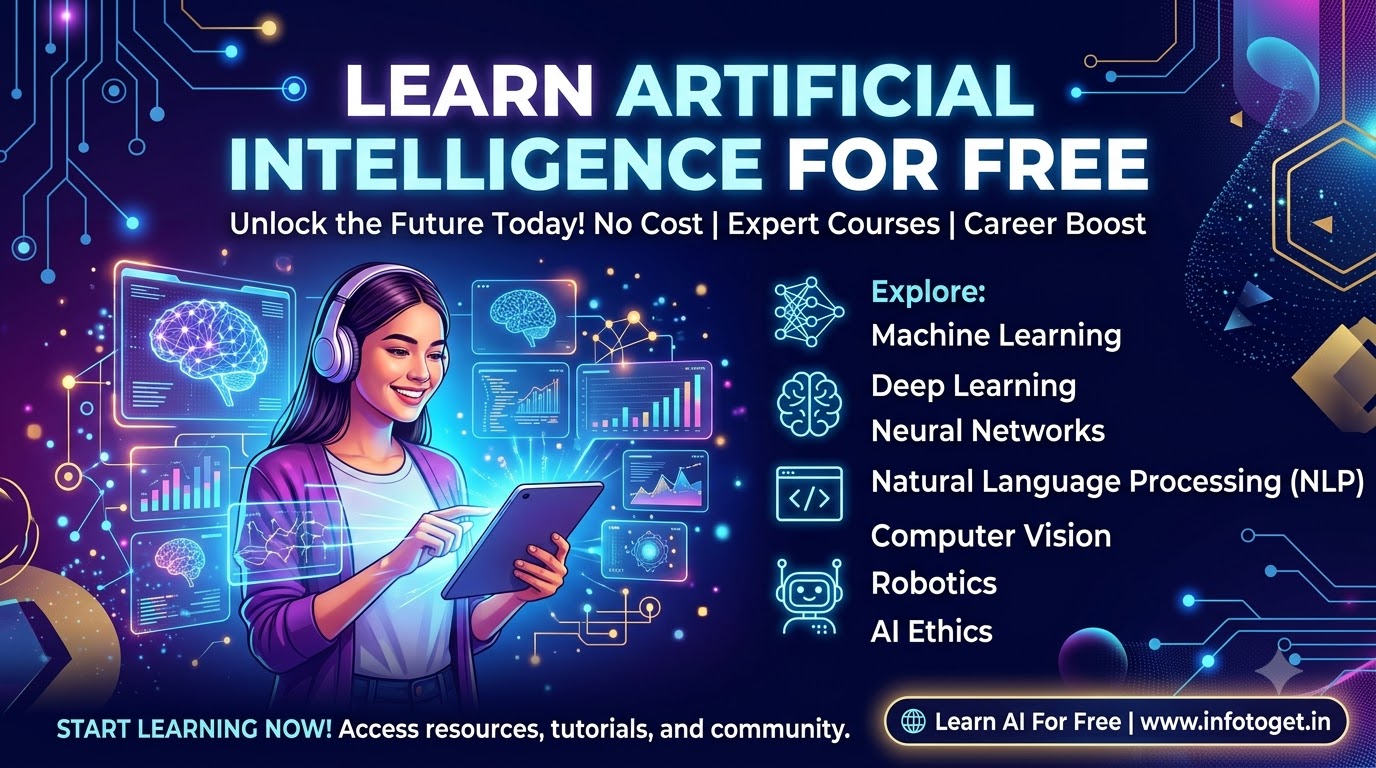
The rapid advancement of artificial intelligence (AI) has dramatically transformed industries worldwide, from healthcare and finance to creative media and software engineering. Historically, mastering a cutting-edge field like machine learning required thousands of dollars in university tuition, specialized master’s degrees, or costly coding bootcamps. However, the technology landscape has undergone a massive educational revolution. Today, you no longer need an intermediary to learn artificial intelligence. The pioneering tech companies, research institutions, and hardware manufacturers that build these foundational AI models are now offering comprehensive, enterprise-grade educational resources directly to the public—completely free of charge.
By going directly to the original creators, self-taught developers, students, and professionals can access up-to-date documentation, real-world engineering practices, and hands-on coding environments. This direct access removes traditional academic gatekeeping, allowing anyone with an internet connection to gain industry-recognized skills. Whether you want to build generative AI applications, fine-tune open-source models, optimize cloud infrastructure, or understand the mathematical foundations of machine learning, this definitive guide provides a thorough breakdown of the top twelve free learning platforms created by the architects of modern artificial intelligence.
Why You Should Learn Directly from AI Builders
When learning technology through traditional university textbooks or third-party online courses, curriculums often lag behind real-world software releases by months or even years. In a field moving as fast as artificial intelligence, learning outdated framework syntax can hinder your progress.
- Cutting-Edge Accuracy: Primary model developers update their educational materials instantly as new architecture releases, SDKs, or safety protocols launch.
- Real-World Engineering Standards: Instead of hypothetical academic assignments, these platforms showcase production-level code, real API structures, and enterprise cloud deployments.
- Zero Financial Barriers: Top-tier companies offer these modules freely to cultivate global talent and build thriving ecosystems around their proprietary or open-source platforms.

Detailed Breakdown of the 12 Best Free AI Learning Platforms
1. Anthropic: Mastering Claude and Constitutional AI Safety
- Platform URL: http://anthropic.skilljar.com
- Core Focus: AI Safety, Prompt Engineering, and Enterprise Claude Integration.
- Detailed Overview: Anthropic is widely recognized as a premier AI research laboratory dedicated to building helpful, harmless, and honest AI systems. Best known for their Claude family of large language models, Anthropic’s learning portal provides developers with deep insights into “Constitutional AI”—a framework designed to align model outputs with human values.
- Key Learning Outcomes: Learners explore advanced prompt engineering techniques, contextual window utilization, system prompt design, tool use (function calling), and methods for embedding Claude into enterprise applications securely while mitigating hallucination risks.
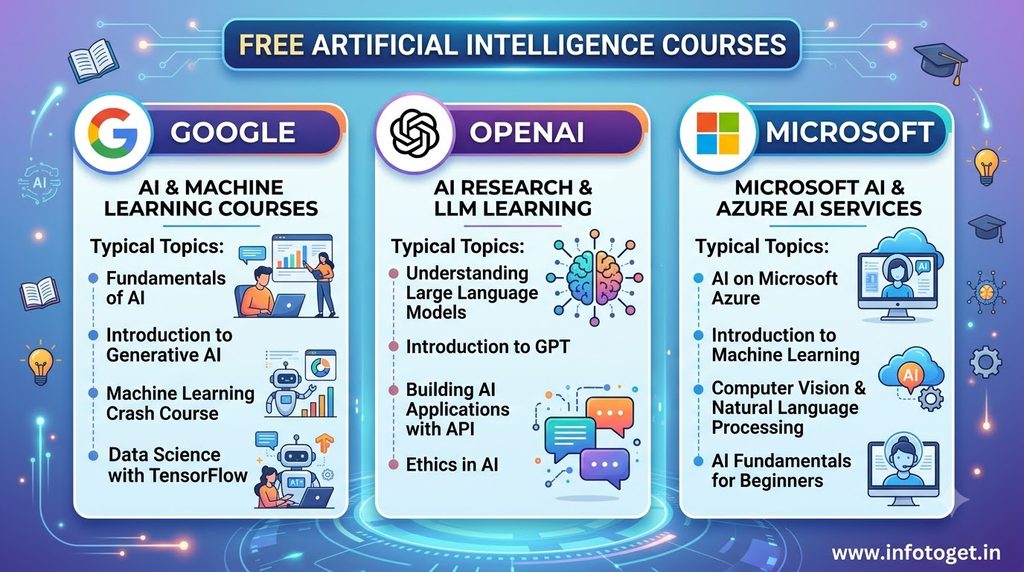
2. Google: Generative AI and TensorFlow Ecosystem
- Platform URL: http://grow.google/ai
- Core Focus: Fundamentals of AI, Gemini Integration, TensorFlow, and Google Cloud AI.
- Detailed Overview: As an early pioneer of modern deep learning—having authored the seminal “Attention Is All You Need” paper that introduced the Transformer architecture—Google offers one of the most comprehensive learning ecosystems available. The Grow with Google AI portal caters to beginners, business leaders, and seasoned developers alike.
- Key Learning Outcomes: Participants learn how Large Language Models work, how to utilize Google Gemini APIs, how to train neural networks using TensorFlow and PyTorch, and how to deploy serverless machine learning pipelines on Google Cloud Platform (GCP).
3. Meta: Open-Source AI, PyTorch, and Llama Frameworks
- Platform URL: http://ai.meta.com/resources
- Core Focus: PyTorch Framework, Open-Source Llama LLMs, and Computer Vision.
- Detailed Overview: Meta has positioned itself as the global leader in open-source artificial intelligence. By creating PyTorch—the default framework used by global AI researchers—and releasing the state-of-the-art Llama family of open weights models, Meta provides developers with unprecedented access to model internals.
- Key Learning Outcomes: Through Meta’s official resource portal, learners gain hands-on experience building neural networks with PyTorch, fine-tuning Llama models locally or in cloud environments, implementing computer vision algorithms, and integrating open-source AI into production apps.
4. NVIDIA: High-Performance Computing, CUDA, and Deep Learning
- Platform URL: http://developer.nvidia.com/training
- Core Focus: GPU Acceleration, CUDA Programming, Deep Learning, and Computer Vision.
- Detailed Overview: NVIDIA’s graphics processing units (GPUs) serve as the physical engines driving global AI model training and inference. The NVIDIA Deep Learning Institute (DLI) provides specialized training aimed at hardware acceleration, computational speed, and deep learning engineering.
- Key Learning Outcomes: Developers learn parallel computing fundamentals using CUDA, optimization of deep learning models for real-time video processing, building autonomous robotics systems, and scaling multi-GPU workloads across large data center infrastructure.
5. Microsoft: Enterprise AI, Azure Machine Learning, and Copilot
- Platform URL: http://learn.microsoft.com/training
- Core Focus: Enterprise AI Deployments, Azure OpenAI Services, and Copilot Extensions.
- Detailed Overview: Microsoft’s massive strategic partnership with OpenAI has made its Azure cloud the destination for corporate enterprise AI solutions. Microsoft Learn provides structured, self-paced learning paths that prepare developers and system administrators for real-world enterprise implementations and official certifications.
- Key Learning Outcomes: Students learn how to deploy OpenAI models inside secure Azure environments, build custom AI plugins, manage enterprise data governance, implement vector databases for Retrieval-Augmented Generation (RAG), and create automated workflows using Microsoft Copilot Studio.
6. OpenAI: Prompt Engineering, Fine-Tuning, and GPT APIs
- Platform URL: http://academy.openai.com
- Core Focus: GPT Architecture, API Integration, Fine-Tuning, and Autonomous Agents.
- Detailed Overview: As the company that kicked off the global generative AI boom with ChatGPT, OpenAI offers direct educational resources for building next-generation applications. The OpenAI learning hub helps developers move beyond simple chatbot prompts to design intelligent system architectures.
- Key Learning Outcomes: Learners master structured JSON outputs, function calling, custom GPT creation, speech-to-text processing using Whisper, vision capabilities, embeddings for semantic search, and cost-effective fine-tuning of GPT models for specific domain tasks.
7. IBM: Enterprise Automation, AI Ethics, and SkillsBuild
- Platform URL: http://skillsbuild.org
- Core Focus: Enterprise Watson Architecture, Data Governance, and AI Ethics.
- Detailed Overview: IBM has remained at the forefront of business-focused computing for over a century. Through the IBM SkillsBuild program, learners can access curated, job-ready pathways designed to equip students and career changers with fundamental data science and enterprise AI skills.
- Key Learning Outcomes: The platform covers foundational machine learning concepts, natural language processing, data analysis, automated workflow orchestration with IBM watsonx, and critical frameworks for ethical AI governance in corporate environments.
8. AWS: Cloud Machine Learning, SageMaker, and Bedrock
- Platform URL: http://skillbuilder.aws
- Core Focus: Cloud Infrastructure, Amazon SageMaker, and Amazon Bedrock.
- Detailed Overview: Amazon Web Services (AWS) powers a vast percentage of the world’s cloud computing infrastructure. The AWS Skill Builder platform features dedicated learning plans focused specifically on machine learning engineering and cloud deployments.
- Key Learning Outcomes: Students learn how to build, train, and deploy machine learning models using Amazon SageMaker, leverage foundation models securely using Amazon Bedrock, manage cloud storage for massive datasets, and enforce strict identity access management (IAM) security policies.
9. DeepLearning.AI: Neural Networks and Foundational Machine Learning
- Platform URL: http://deeplearning.ai
- Core Focus: Deep Learning Fundamentals, Neural Networks, and Generative AI Applications.
- Detailed Overview: Founded by AI pioneer and Stanford professor Andrew Ng, DeepLearning.AI is one of the most respected educational institutions in the technology space. The platform offers short, highly focused courses developed in collaboration with top tech companies to bridge theoretical concepts with practical application.
- Key Learning Outcomes: Learners master convolutional neural networks (CNNs), recurrent neural networks (RNNs), hyperparameter tuning, structuring machine learning projects, building RAG applications, and deploying AI agents.
10. Hugging Face: Open-Source Transformers, Datasets, and Model Deployment
- Platform URL: https://huggingface.co/learn
- Core Focus: Open-Source Transformers, NLP, Diffusers, and Dataset Management.
- Detailed Overview: Known across the industry as the primary open-source hub for machine learning models and datasets, Hugging Face provides interactive, hands-on learning resources. Their courses teach developers how to harness thousands of pre-trained models created by researchers worldwide.
- Key Learning Outcomes: Students learn how to use the
transformerslibrary, process natural language and audio data, train image generation models using diffusers, publish custom datasets, and build interactive web demos using Gradio and Hugging Face Spaces.
11. Apple: On-Device Machine Learning, Core ML, and Privacy-Focused AI
- Platform URL: https://developer.apple.com/machine-learning/
- Core Focus: On-Device Machine Learning, Core ML, Create ML, and Privacy Optimization.
- Detailed Overview: Apple approaches machine learning with a strong emphasis on user privacy, on-device processing power, and energy efficiency across iOS, iPadOS, macOS, and watchOS devices. Apple’s developer portal guides creators through optimizing models for personal hardware.
- Key Learning Outcomes: Developers learn how to convert PyTorch and TensorFlow models into Core ML format, train custom image and text classifiers with Create ML, execute real-time computer vision using hardware Neural Engines, and maintain strict data privacy compliance.
12. Stanford Online: Deep Mathematical Foundations and CS221
- Platform URL: https://online.stanford.edu/courses/cs221-artificial-intelligence-principles-and-techniques
- Core Focus: Mathematical Foundations, Search Algorithms, Machine Learning Theory, and Logic.
- Detailed Overview: For students seeking a rigorous academic foundation equal to elite university degree programs, Stanford University offers free online access to its flagship course materials, including CS221 (Artificial Intelligence: Principles and Techniques).
- Key Learning Outcomes: Students explore the mathematical mechanics behind machine learning, constraint satisfaction problems, Markov decision processes, adversarial search, Bayesian networks, logic-based models, and foundational statistical learning theory.
Step-by-Step Roadmap: How to Begin Your AI Journey
Attempting to dive into all twelve platforms at once can quickly lead to cognitive overload. To maximize your learning efficiency, follow this structured four-phase roadmap:
[Phase 1: Foundations] -> [Phase 2: Frameworks & Building] -> [Phase 3: Cloud & Scale] -> [Phase 4: Specialization]
Phase 1: Establish Foundational Knowledge
Start by understanding fundamental concepts without getting bogged down in complex mathematics.
- Recommended Sites: Elements of AI (or Stanford CS221 for mathematical rigor) and DeepLearning.AI.
- Goal: Understand the difference between artificial intelligence, machine learning, and deep learning.
Phase 2: Master Frameworks and Build Locally
Learn to write functional code using modern developer tools and open-source models.
- Recommended Sites: Hugging Face and Meta (PyTorch).
- Goal: Build small, working projects on your personal computer, such as a sentiment analysis script or a local image classifier.
Phase 3: Learn API Integration and Fine-Tuning
Learn how to leverage industry-leading commercial models inside software applications.
- Recommended Sites: OpenAI Academy, Anthropic, and Google AI.
- Goal: Build a full-stack web app that connects to an LLM API to perform complex tasks like document summarization or function execution.
Phase 4: Deploy at Scale in the Cloud
Understand enterprise architecture, hardware acceleration, and production pipelines.
- Recommended Sites: AWS Skill Builder, Microsoft Learn, or NVIDIA DLI.
- Goal: Deploy containerized models on cloud servers with automated scaling and real-time monitoring.
Conclusion: Take Control of Your Career
The democratization of artificial intelligence education represents one of the greatest opportunities in modern technical history. The traditional excuses of high university costs and inaccessible research labs no longer apply. The tech giants driving the AI revolution have laid out their documentation, video lectures, coding environments, and best practices completely for free.
By dedicating just a few hours each week to these official, direct-from-source platforms, you can transform yourself from a passive user of AI technology into a skilled creator, developer, and innovator. Select the track that aligns best with your career goals, build hands-on portfolio projects, and start shaping the future of technology today!